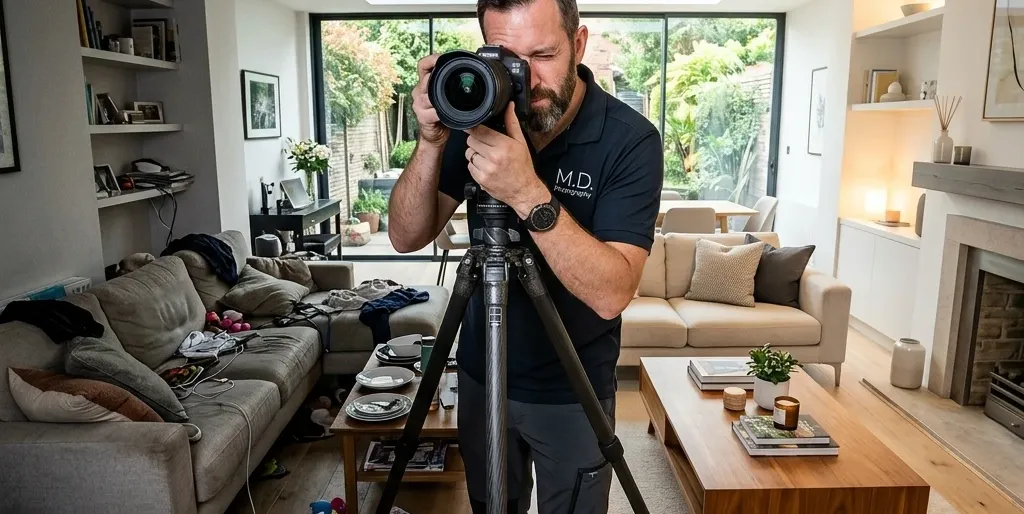
Smartphone or pro photographer: the real estate debate
The "smartphone vs camera" debate is over: computational photography closed the gap, and a recent phone in the right hands produces perfectly publishable property images. The real question sits elsewhere: the same phone in amateur hands and in professional hands does not produce the same photo — because the pro knows the 3-second rule, reads light, and guarantees the final result whatever the tool. And for an agency, outsourcing isn't a quality expense: it's agent time recovered and a deductible business cost, versus reshoots that nobody can invoice.
"The latest iPhone takes amazing photos — why pay a photographer?" The question starts from a correct observation: yes, your smartphone takes excellent photos today. Where it goes wrong is in what it compares. The match was never really "phone versus camera body." It's "amateur versus professional" — and technology hasn't closed that one. As a working real-estate photographer, I shoot on a full-frame body or on a smartphone depending on the job: let's talk honestly about what actually makes the difference in 2026.
The gear debate is settled (and that's good news)
Let's say it plainly: computational photography — automatic exposure blending, multi-frame processing, software lens correction — has caught up with most of what justified the big sensor for everyday property work. A recent smartphone handles a bright window in a dark room better than the DSLRs of a decade ago. At portal size, on a screen, the sensor difference has become marginal.
What has not changed is everything else: knowing where to place the camera, what to show, what to hide, when to shoot, and what the final image must look like. The hardware got democratised; the eye didn't.
The 3-second rule: what the pro knows before pressing the button
On a property portal, a buyer gives your lead photo about 3 seconds before moving to the next listing. The entire professional method flows from that constraint — and it applies to a smartphone exactly as to a camera body:
| Decision | Amateur reflex | Professional method |
|---|---|---|
| Framing | — Shot from the doorway, 'to show everything' | Chest height, composition that guides the eye to the room's strongest feature |
| Verticals | — Tilted phone, trapezoid walls | Levelled camera — a 2-second habit 90% of people don't know |
| Light | — Shot at whatever time the visit happens | Time chosen by orientation; lights on or off depending on the intended look |
| Preparation | — The room 'as it is' | 5 minutes of express staging before every frame: chair turned, cable hidden, worktop cleared |
| The series | — 40 redundant photos | 15-25 images that tell the property in visit order, no duplicates |
| Final look | — The phone's auto filter | Consistent editing across the whole series: true whites, even exposure, the same style listing after listing |
That's exactly why a pro with a plain smartphone beats an amateur with a €4,000 body: the result is predictable. The professional knows what the published image will look like before pressing the shutter — that's the craft. The typical amateur mistakes are documented in our 5 real-estate photography mistakes that scare buyers away.
What the data says — read properly
The public numbers confirm the impact, provided you read them correctly:
Redfin's reference study compared homes photographed "with DSLRs" — but what it actually measured was the effect of professional work: back then, only pros shot DSLR. The causal variable was never the sensor; it's the person behind it. National Association of Realtors research confirms the buyer side: nearly every search starts online — your photos ARE the first viewing, whatever device took them. And for international buyers browsing coastal Spain from Stockholm or Brussels, the photos often carry the entire decision before a flight is ever booked.
The real agency calculation: time, reshoots, deductible costs
Here's the argument the gear debate completely hides — and the one that actually decides:
- Agent time is your hidden cost
An agent photographing a property spends 45-90 minutes on it (prep, shots, sorting, rough editing) — time taken from viewings, valuations and mandates, where they actually generate revenue. The photographer delivers while the agent sells.
- Nobody can invoice a reshoot
Failed photos mean a second trip, re-preparing the property with the owner, days lost on the portal. A professional delivers right the first time — that's precisely what you're buying: a guaranteed result, not megapixels.
- It's a business expense, not a loss
An outsourced shoot is a deductible agency cost — wasted agent time deducts nowhere. At €150-350 per shoot (see our pricing guide), the accounting arbitrage is quick.
- Consistency builds your brand
An outsourced flow guarantees the same style across every listing — what makes an agency window recognisable and reassures sellers at valuation. Consistent imagery wins mandates: we detailed the mechanism in 'agents who show up sell faster'.
Set against the stakes — our real price ranges come to roughly 0.1% of a €250,000 property — the professional shoot behaves like the 360° virtual tour: a tiny fixed cost protecting price and time on market.
When doing it yourself is the right call
An honest article says it clearly: in several cases, the agent or owner with their phone does the job perfectly well — especially applying the method above:
- Fast-rotation simple rentals: daylight, levelled phone at chest height, room prepared with our pre-shoot checklist — plenty.
- Top-up photos: the garden in summer, the renovated kitchen — 2-3 consistent phone images complement an existing professional set very well.
- Social content: stories, behind-the-scenes, before/afters — the smartphone is the format's native tool.
Open your most strategic live listing on your phone, next to the 5 competing listings in the same area and price band. Scroll like a hurried buyer: 3 seconds per lead photo. If your property doesn't win that contest, the problem isn't your device — it's the method. And method can be bought, or learned.
FAQ
Is a smartphone good enough for real estate photography today?
What is the 3-second rule in real estate photography?
Why do agencies outsource photos if an agent can take them?
Are the professional-photo studies still valid in the smartphone era?
When can I take the photos myself?
Further reading
Win the 3-second contest
Real-estate photographer between Belgium and the Costa Daurada, I deliver a guaranteed result while your agents sell — let's talk about your listing flow.
Book a shoot